

解
Aimee
Before her canonization in 1920, St Joan of Arc’s name possibly could have been Jehanne d’Arc, Jehanne Tarc, Jehanne Romée or/and Jehanne de Vouthon. And Jehanne could have been Jehanette.ii Names were quite fluid and flexible during those times. Joan d’Arc’s date of death (May 30th, 1431) is recorded in time, while her birthday is a place and believed to be January 6, 1414. Records were not kept at this time (1400s) of the world as the majority of the population, including Jehanette, were illiterate.
It is known that she hailed from Domrémy, as did Aimée Girod (1856–1937). Aimée became the model specifically selected by Emmanuel Fremiet (1824–1910) for the famous equestrian statue of St. Joan of Arc. Subsequently, her selection was location symbolic.
Fremiet’s work was public commissioned in 1870 which was the golden age of statuary in France. Inaugurated 1874, the gilded bronze statue Jeanne d’Arc was placed at the Place des Pyramides. Thatoriginal was modified ten years later and reproduced in 5 copiesvi. Besides his original work, the other versions are located in Nancy France, Philadelphia, Melbourne Australia, Portland Oregon and New Orleans. However, this work is widely copied by other artists and there are 37 other equestrian Joanies on ponies in the world essentially with the same model much during statuomania. Riding this equestrian theme, statues with riders of fame such as Stephen III of Moldavia in Iasi, Rumania, Napoléon I in Laffrey, Louis d’Orléans in Pierrefonds and Bertrand du Guesclin in Dinan came to the public arts. After St. Joan, Fremiet went on to produce some notable works. His works Gorille enlevant une femme and Borneo Savage (on display in the foyer of the Gallery of Palaeontology and Comparative Anatomy in Paris) explored/exploited the theme of “ape phobia”.
Nancy Joanie was responsible for her make over. The city requested a copy of the original, thereby allowing Fremiet to modify his work by reducing the size of the horse and placing a muzzle over the horse head. Fremiet was allegedly stung by the criticism of his original particularily the “small peasant girl on a big farm horse”. Critics abound, never mind that a complete male suit would have been impracticle for this heroine.
The copy that found its way to the present location in New Orleans traveled a rather unusual storage maze through time. From storage in France, to storag e in New York, to storage in New Orleans. Once in New Orleans, it remained in storage, despite being gifted to New Orleans by Charles DeGaulle, until liberation in the business district Rivergate Convention Center in 1974. “Joanie on her pony” relocated again after Harrah’s Casino paid to have her moved to her current location in the Place de France amongst the French Market. She is a hit in New Orleans and every year a Krewe de Jeanne d’Arc Joyeux Anniversaire, Jeanne d’Arc celebrating the unofficial saint of New Orleans on her unofficial birthday.
Philadelphia Joanie did not include as much stored imprisonment. Arriving as a bronze and inaugurated in 1890. It was moved in 1948 near the Philadelphia Museum of Art. It has since been gilded to gold twice.
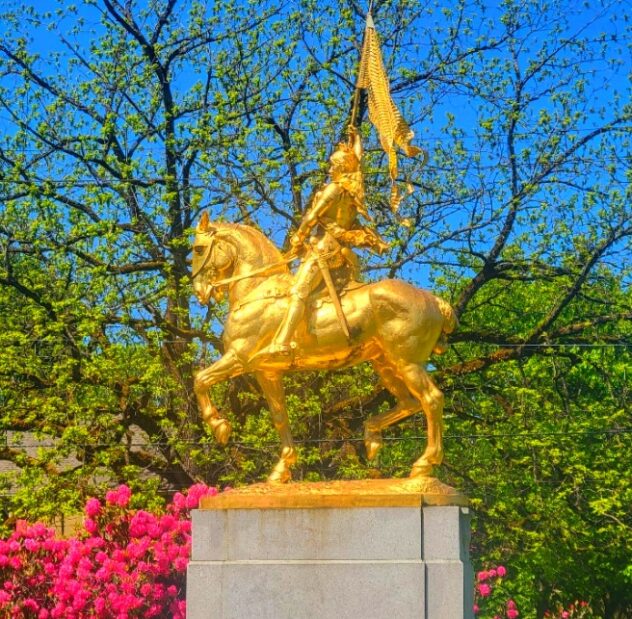
Portland Joanie shared some time with New Orleans Jehanne while stored in France, then arriving in Oregon in 1924.i She was a private donation to the city and inaugurated on Memorial day dedicated in honor of the Doughboys of World War I who considered St. Joan their patron saint. The soldiers allegedly sang “Joan of Arc, They are Calling You”
Melbourne Joanie arrived by the French mail steamer Dumbéa from Marseilles on 28 January 1907 and was quite controversial. Considering that she had driven the English out of Orleans. The Maid of Orleans retains the bronze patina but mysteriously has lost her wreath crown.
.jpg#:~:text=File:StateLibQld%201%20141499%20Dumbea%20(ship).jpg.%20Size%20of%20this%20preview:%20800&text=English:%205%2C867%20GRT%20passenger%20liner%20Dumb%C3%A9a%20leaving%20La%20Joliette%2C%20Marseille%2C%20France.)
Jehanne rose in French ranks during the Franco – Prussian war. She was subsequently captured, imprisoned for a year and sold to the English. They in course, put her on trial charging her as a heretic by, among other things, acting on visions and wearing the clothes of men. So much for the mail suit.
During the trial she identified herself as “Jehanne la Pucelle” (“Joan the Maid”). She was convicted and eventually burned at the stake.
Although she is known by many names, honored as a patron saint, revered as a strong women figure…. not much is really known about her physical characteristics. A historical initial depiction of Joan of Arc is dated to mid 15th century but is suspected of being a forgery. And a drawing by Clément de Fauquembergue shows that he would never be hired as a sketch artist. Along with the horse theme, there have been countless paintings and renditions of her through the ages and her true likeness is lost in diversity and myth.

Aimee Girod the model of Jeanne, faded into anonymity and abject poverty. Despite her obscutity, it is the likeness and image of Aimee Girod that is seen throughout the world and through the work of Fremiet. Aimee died in Paris and like Joan in fire.